In the United States and in other parts of the world, Valentine’s Day is synonymous with chocolate, often presented in heart-shaped boxes such as these:
This wasn't always the case.
St. Valentine's Day originally traces back to a pagan fertility festival in Ancient Rome, before anyone in that part of the world had ever tasted the
Food of the Gods.
 |
| Mayan Cacao God |
Why do we love chocolate so much? From the above link, Claire Spampinato explains:
"[E]ach 100 grams of chocolate contains 660 mg of phenylethylamine (C6H5(CH2)2NH2), a stimulant similar to the body's own dopamine and adrenaline. Phenylethylamine raises blood pressure and heart rate, and it heightens sensation and blood glucose levels. In fact, it is identical to a hormone produced by the brain when a person feels infatuated-which could explain the chocolate/Valentine's Day connection."
 |
| phenylethylamine |
So, in essence, chocolate makes us feel good in the same way that we feel good when we have a romantic interest in another person.
Valentine’s Day also provides us with a number of different avenues for discussing specific sociological concepts. Holidays in general have always been connected with cultural diffusion. Christmas, for example, has its origins in pagan winter festivals, the traditions of which can be seen in modern festivities: Christmas trees, Yule logs, flying reindeer, kissing under the mistletoe, etc. Christmas is perhaps the most significant holiday in America, but this was not always the case. In Puritan New England, some colonies banned the observation of the holiday because the revelry and pagan customs conflicted with stringent Puritan values.
While Americans and Canadians have in recent years begun to embrace Eastern holidays such as
Chinese New Year, Valentine’s Day has been
innovated into Eastern cultures as well, with different results.
In Japan, Valentine’s Day customs reflect the
folkways of Japanese society. On February 14
th, women across Japan are obliged to present their
honmei (“sweethearts”)
with chocolates and gifts. In the International Journal of Japanese Sociology, Volume 5, Issue 1, pages 41-66, November 1996, Yuko Ogasawara takes a close look at this chocolate-fueled dynamic between the sexes. Below is the full abstract taken from
this link.
"Valentine's Day as practiced in contemporary Japan constitutes a cultural puzzle. Comparison of Japanese and American Valentine's Days using data collected through interviews with twenty Japanese and twenty Americans reveals three customs peculiar to the Japanese holiday: an emphasis on chocolate; exclusively women-to-men gift giving; and the prevalence of giving “obligatory chocolate” within offices. Although chocolate companies' promotional activities go a long way toward explaining the first custom and arguably the second, women giving chocolate to male colleagues and supervisors is an adaptation of the original formula made by the participants themselves. Because Valentine chocolate is a highly symbolic gift with the message “I admire you,” whether or not they receive chocolate matters to men. By imbuing the gift with meanings which men find difficult to ignore, women are able to enjoy a temporary power over men. The study strongly asserts the cultural freedom people possess in creating new meanings from available codes."
Meanwhile in India, Valentine’s Day has not been so universally embraced. This holiday that encourages an open expression of affection violates traditional Hindu
mores regarding propriety of conduct between men and women. Some of the
sanctions that couples have experienced include forcible hair-cutting, forced marriage, and
being arrested.
 |
Valentine's Day protests in India and Pakistan
are common and sometimes violent. |
Stratification is yet another issue that relates to the chocolate industry. On Valentine's Day, we think of chocolate as a food that brings people together, at least in pairs. But the very process of cultivating cacao is divisive, on a macrosociological scale. It may come as a surprise to many Americans that
slavery still exists on this planet, and we still continue to benefit from the exploitation of slave labor. There is a great deal of information on slavery in the cacao industry on
this link.
But back in the U.S., Valentine's Day is fast approaching. This week's recipe is for Molten Chocolate Lava Cakes, from
food is luv. This dessert is just right for two and is sure to warm your hearts. Please consider using
Fair Trade Chocolate when you make this recipe.
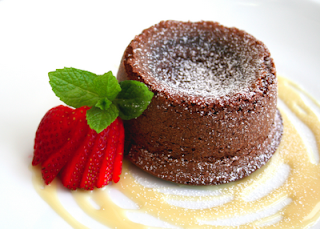 |
| Molten Chocolate Lava Cakes, from "food is luv". |


